
Questions?
(800) 604-5537
ADA truncated dome mats — cast-in-place and surface-mount, composite and cast iron — in every stocked size and color. Authentic Access Tile, Armor Tile, and Advantage. Free shipping.
A detectable warning mat — also called a truncated dome mat, tactile paving, or detectable warning surface — is a panel of raised domes that alerts pedestrians who are blind or have low vision that they're approaching a hazard such as a curb ramp, crosswalk, or transit platform edge. As an authorized dealer we stock only authentic Access Tile, Armor Tile, and Advantage mats — never off-brand generic tiles — every one certified ADA compliant.

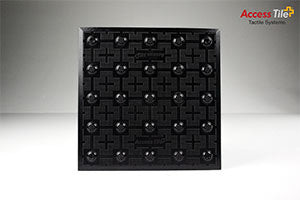

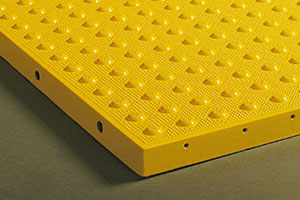

Truncated domes are the raised, flat-topped bumps that make up a detectable warning mat. Arranged in a regular grid across the panel, they provide tactile feedback underfoot and to a cane, warning pedestrians who are blind or have low vision that they're approaching a hazard — while the mat's high-contrast color gives a visual cue. You'll find them at curb ramps, crosswalks, transit platform edges, stair landings, and anywhere a pedestrian route meets vehicle traffic.
Three decisions drive which mat is right for a project: how it mounts (cast in place or surface mount), what it's made of (composite or cast iron), and the size and color you need. The sections below cover each, and the selector tool walks you through all three in order.
Add each location you need to cover, choose how it mounts, the material, size, and color — and build a live parts list of the exact ADA truncated dome mats we stock, with current pricing and one-click add to cart.
Open the Mat SelectorThis is the single most important choice, and it comes down to the state of your concrete:
Rule of thumb: pouring new concrete → cast in place. Sidewalk or ramp already exists → surface mount.
Once mounting is settled, durability is the next question. Most projects use composite tiles; cast iron is reserved for the toughest sites.
| Material | Best For | Notes |
|---|---|---|
| Composite (Access Tile / Armor Tile) | Sidewalks, curb ramps, transit platforms, general pedestrian areas | Glass and carbon reinforced polymer; ADA compliant; widest color range |
| Cast iron (Advantage) | Heavy vehicular traffic — snowplows, forklifts, loading areas | Most durable option; natural grey finish that weathers to a rich patina |
Composite is correct for the vast majority of installations. Reach for cast iron only where heavy vehicles cross the mats or you need maximum service life.
As an authorized dealer we stock only authentic, name-brand tactile surfacing — never off-brand generic mats. All are fully ADA compliant:
The most widely specified ADA tile, with a replaceable design that lets individual tiles swap out in minutes with a Torx driver. Cast in place and surface mount.
Proven glass and carbon composite with 30+ years in the field, plus a couple of extra surface-applied colors (Blue and Light Gray).
The heavy-duty, cast-in-place option engineered to take abuse from rolling loads and extreme weather.
The detectable warning must cover the full width of the ramp or landing and extend the required depth in the direction of travel — commonly 24 inches. We stock mats from 1 ft x 1 ft up to 3 ft x 5 ft, plus radius mats that follow the curve of a rounded curb return. A standard curb ramp often uses a 2 ft x 4 ft or 2 ft x 5 ft mat, and larger areas are covered by combining multiple mats.
Composite mats are stocked in Federal Yellow, Black, Brick / Safety Red, Colonial Red, and Dark Gray, with Armor Tile surface-applied also offered in Blue and Light Gray. Federal Yellow is the most commonly specified because it provides strong visual contrast against gray concrete — but always confirm the color your local jurisdiction requires. Cast iron ships in its natural grey patina, which darkens over time.
Under the ADA and the Public Right-of-Way Accessibility Guidelines (PROWAG), detectable warning surfaces are required wherever a curb ramp, blended transition, or pedestrian route meets a vehicular way, at transit platform boarding edges, and at the edges of reflecting pools without railings. In practice that means curb ramps, crosswalks, and train and bus platforms. Many states and agencies layer on additional specifications for dome spacing, color, and placement, so check your local requirements before ordering. Every mat we sell is certified ADA compliant.
A detectable warning mat — also called a truncated dome mat or detectable warning surface — is an ADA-compliant tactile panel with raised domes that warns pedestrians who are blind or have low vision that they're approaching a hazard such as a street crossing, transit platform edge, or change in elevation. The domes provide underfoot and cane-detectable feedback, and the contrasting color provides a visual cue.
Cast in place mats are set into concrete while it's still wet during a new pour, creating a permanent, flush installation with the strongest bond. Surface mount mats are fastened and bonded onto concrete that's already cured, which makes them the right choice for retrofits and repairs on existing sidewalks and ramps.
Under the ADA and PROWAG, detectable warning surfaces are required wherever a curb ramp, blended transition, or pedestrian route meets a vehicular way, and at transit platform boarding edges and the edges of reflecting pools without railings. They're typically installed at curb ramps, crosswalks, and train and bus platforms. Check local and state requirements, since some agencies add their own specifications.
The detectable warning must cover the full width of the ramp or landing and extend the required depth in the direction of travel — commonly 24 inches. A standard curb ramp often uses a 2 ft x 4 ft or 2 ft x 5 ft mat, and larger areas are covered by combining multiple mats. Radius mats follow the curve of a rounded curb return.
Composite Access Tile and Armor Tile mats are stocked in Federal Yellow, Black, Brick / Safety Red, Colonial Red, and Dark Gray, with Armor Tile surface-applied also offered in Blue and Light Gray. Federal Yellow is the most commonly specified for visual contrast. Advantage cast iron ships in its natural grey patina finish.
Composite mats are correct for the vast majority of pedestrian ADA work — sidewalks, curb ramps, and transit platforms. Cast iron mats are the most durable option and are chosen where heavy vehicles such as snowplows and forklifts cross the surface, or where maximum longevity is required.