
Questions?
(800) 604-5537
Cast iron and PVC floor sinks for commercial kitchens, food service, and industrial washdown — deep and shallow bodies with acid-resistant coatings, half and full grates, and dome strainers. Free shipping.
A floor sink is a recessed receptor that receives indirect waste from sinks, dishwashers, ice machines, and other fixtures, providing the required air gap while catching solids before they reach the sanitary line. Our floor sinks span cast iron and PVC bodies, deep and shallow profiles, and half- or full-grate tops with dome strainers and sediment baskets — built for the sanitation and flow demands of commercial kitchens and industrial spaces.
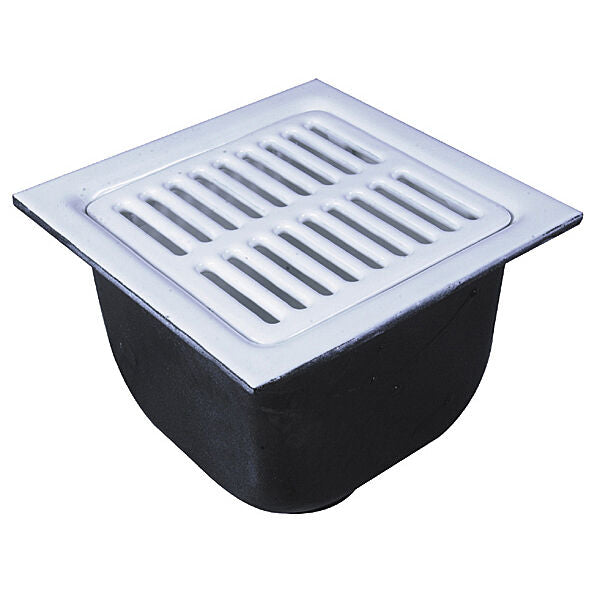
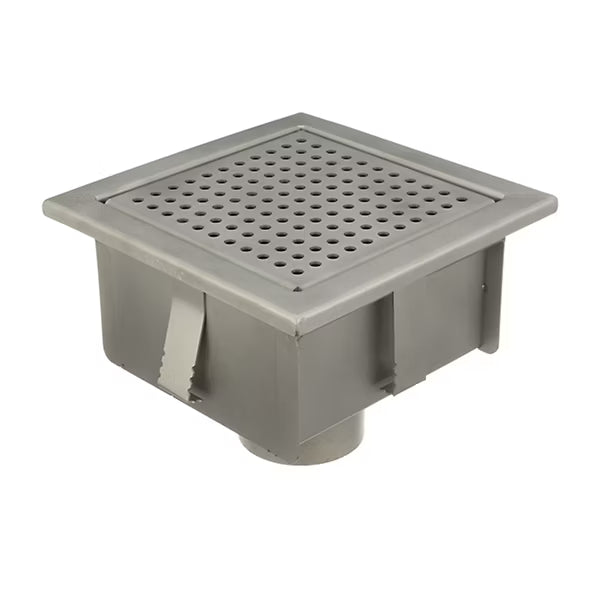
A floor sink is a recessed drainage receptor set flush with the floor that receives indirect waste — the discharge from sinks, dishwashers, ice machines, steam kettles, and similar fixtures. Instead of hard-piping that equipment straight to the sewer, the waste line terminates above the floor sink with an air gap, and the floor sink catches the flow. That air gap is what prevents contaminated water from being siphoned back into potable equipment, which is why floor sinks are required throughout commercial kitchens and food-service spaces.
Most floor sinks pair a coated cast iron or PVC body with a dome (beehive) strainer and a grate. The dome strainer traps solids so they don't clog the line, while the grate supports foot traffic and can be full or half-size depending on how much equipment discharges into the sink.
They look similar and both sit in the floor, but they do different jobs — and mixing them up causes code problems:
Rule of thumb: if equipment drains into it through an air gap, you need a floor sink; if it's catching water off the floor, you need a floor drain.
Match the body and top to the space, the equipment load, and the sanitation requirement:
Durable, heavy-duty bodies with acid-resistant enamel interiors — the standard for commercial kitchens and demanding washdown areas.
Lightweight, corrosion-proof, and lower-cost — a good fit where chemical resistance and easy handling matter more than load.
Deep bodies maximize solids capture and flow; shallow floor sinks fit thin slabs and tight rough-in depths.
Full grates support foot traffic; half grates leave room for multiple indirect-waste lines to discharge into one sink.
A beehive dome strainer keeps debris and food solids out of the drain line while maintaining flow.
Removable baskets make cleanout fast and keep solids from ever reaching the trap and piping.
Tally the fixtures and equipment draining into the sink; more lines favor a half grate and a larger body.
Cast iron for heavy-duty kitchens and durability; PVC for chemical resistance and lighter installs.
Match the body depth to your slab and rough-in — use a shallow floor sink where depth is limited.
Select full or half grate, dome strainer, and a sediment basket; confirm outlet size and load rating.
Always confirm outlet size and type, body material, depth, grate style, and accessories against the plumbing schedule and local code before ordering.
A floor sink receives indirect waste — the discharge from sinks, dishwashers, ice machines, and similar equipment — through an air gap. It provides the sanitary separation that plumbing codes require in commercial kitchens and food-service areas, while its dome strainer catches solids before they reach the drain line.
A floor sink receives indirect waste from fixtures and equipment through an air gap and has a deeper body with a dome strainer. A floor drain collects surface water off the floor — spills, washdown, and condensation — and sends it to the sanitary or storm line. If equipment drains into it, you need a floor sink; if it's catching water off the floor, you need a floor drain.
Cast iron floor sinks are the heavy-duty standard, with acid-resistant enamel interiors for demanding commercial kitchens. PVC floor sinks are lighter, lower-cost, and highly corrosion resistant, which suits chemical environments and installs where weight and handling matter more than maximum durability.
A half grate covers only part of the floor sink opening, leaving the other half open so several indirect-waste lines can discharge into the sink while the grated half still supports foot traffic. Full grates are used where the sink mainly needs to be walked over.
Yes. Like other drains, a floor sink connects to a trap that holds a water seal against sewer gas. In areas where the sink sees little flow, add a trap primer so the seal doesn't evaporate and let odors into the space.
Use the dome strainer and a removable sediment basket, and clean them on a regular schedule — daily in busy kitchens. The strainer and basket capture food solids and debris so they never reach the trap and piping, which is the most common cause of floor-sink backups.