
Questions?
(800) 604-5537
High-strength channel and trench drains for driveways, patios, parking areas, and commercial walkways — complete kits with ductile iron grates and H-20 load ratings. Free shipping.
A trench drain (also called a channel drain) captures sheet-flow runoff across a surface and carries it to an outlet — the fast fix for water pooling on a driveway, patio, or slab. Our NDS channel and trench drain kits pair a rugged neutral-invert channel with ductile iron grates, end outlet, end cap, and grate locks so you get pro-level drainage and a faster install with no parts hunting.
A trench drain — also called a channel drain — is a long, narrow surface drain that intercepts water flowing across a paved area and channels it to an outlet. Where a spot drain catches water at a single point, a trench drain captures sheet flow along its entire length, making it the go-to solution for driveways, garage aprons, patios, pool decks, parking lots, and commercial walkways.
Each NDS channel drain kit bundles a neutral-invert channel with ductile iron grates, an end outlet, an end cap, grate locks, and fasteners — everything needed for a high-strength, reliable run without guesswork or parts hunting.
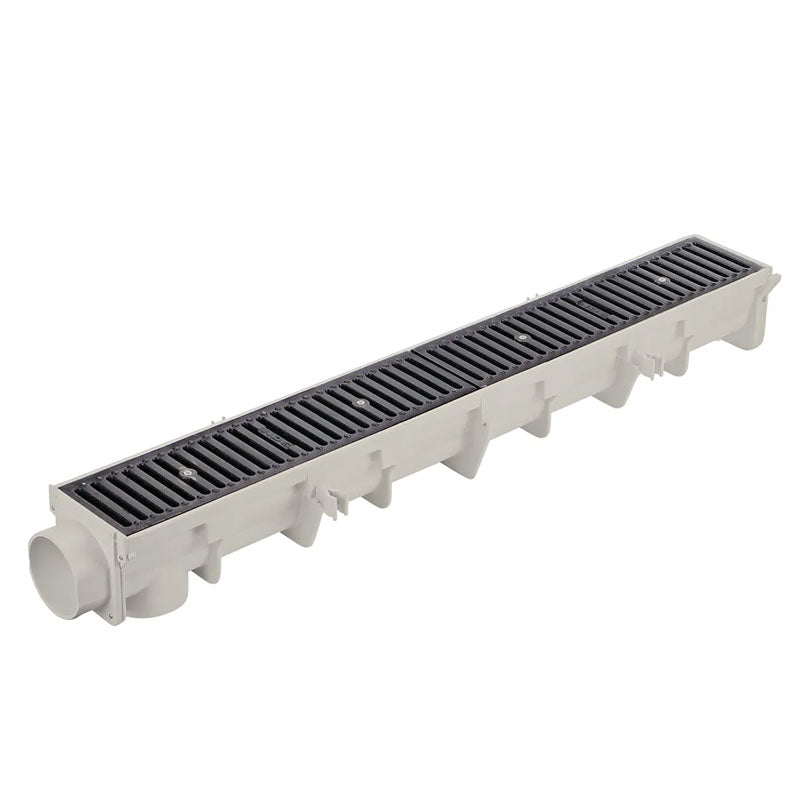
Neutral channel section, two ductile iron grates with fasteners, end outlet, end cap, and grate locks — less install time and parts management.
Ductile iron handles heavier-duty environments and frequent traffic without corroding.
6" wide × 4 ft long, 4.3" invert depth, 6.1" total depth — strong hydraulic capacity in a compact, rugged form.
A flat channel base means you set the slope — ideal where site grade is minimal or tightly controlled by the installer.
Rated for H-20 vehicular load under proper installation — suited to driveways, parking zones, and patios expecting vehicle stress.
Locks hold grates in position during and after the pour, and make debris removal and maintenance quick.
The grate sets the load rating, so match it to your traffic:
Rule of thumb: ductile iron for vehicles and H-20; galvanized steel for Class C, pedestrian, and light-duty runs.
Trace the flow path — find the low edge (garage threshold, apron, patio perimeter) where water naturally travels.
Confirm elevations — because the channel is neutral invert, you set the grade; plan a continuous fall toward your outlet.
Check capacity — the 6" × 4 ft channel with 4.3" invert depth handles most residential and light commercial runs; add outlets on longer lines.
Pick a grate — ductile iron for vehicles/H-20, galvanized steel for Class C/light duty. Make sure the rating fits your traffic.
Plan the outlet — use the included end outlet and cap; tie into storm piping, a French drain, or a dry well per local code.
The sequence is straightforward: dig, set grade, place the channel, encase, fasten grates, and connect the outlet.
Excavate & bed — dig a trench wide and deep enough for the channel plus concrete bedding/encasement. Compact the sub-base.
Set grade — establish a consistent fall toward the outlet (a laser level helps). Neutral invert means you control the slope.
Place channel — dry-fit sections and verify height against adjacent surfaces (concrete, pavers). Lock grates to hold geometry.
Encase — concrete backfill per load rating (H-20 requires proper encasement). Keep grates in place during the pour.
Connect the outlet — attach the end outlet to storm piping, seal joints per local code, and finalize the grate fasteners.
Location: Suburban home on a mild slope. Problem: after heavy rain, water tracked into the garage and pooled along the driveway apron — and re-grading the entire drive wasn't in the budget.
Solution: a trench drain run using one 4-ft neutral channel with ductile iron grates, set to a 0.7% installer-controlled grade. The included end outlet tied directly into existing storm piping, and concrete encasement followed H-20 guidelines for occasional vehicle loads.
Outcome: installed in one afternoon by a crew of two. No ponding or garage intrusion through two subsequent storms of more than an inch of rain, and the apron dried noticeably faster. Quarterly visual checks keep it clear, and the grate locks make debris removal easy.
A trench drain (or channel drain) is a long, narrow surface drain that intercepts water flowing across a paved area and carries it to an outlet. It captures sheet flow along its whole length, which makes it ideal for driveways, patios, pool decks, parking areas, and commercial walkways.
They're the same thing — "trench drain" and "channel drain" are used interchangeably for a linear surface drain with a channel body and a removable grate. NDS channel drain kits are simply pre-bundled with the grates, outlet, cap, and locks you need.
It means the channel base is flat, with no built-in slope. You set the fall during installation, which is helpful when site grades are tight or you need precise control over the drainage direction.
Use ductile iron for vehicle traffic and heavy-duty H-20 applications like driveways and parking areas. Choose galvanized steel for light-duty or pedestrian areas where weight and cost matter — note it reduces the rating to Class C and needs two grates per channel.
Yes. With ductile iron grates and proper concrete encasement, these kits are rated for H-20 vehicular load, which covers driveways, garage aprons, and parking zones. The load rating depends on correct installation, so follow the encasement guidance for your traffic.
Check seasonally and after major storms. Remove the grates, clear debris, and re-fasten the locks. Heavily treed sites may need more frequent checks in fall when leaves accumulate.