
Questions?
(800) 604-5537
High-performance polyester soil reinforcement for retaining walls, steep slopes, embankments, and roadbase support. Free shipping.
These high performance soil reinforcement products are ideal for structural soil support. The grids are constructed from polyester yarns that have a high molecular weight and tensile strength. These yarns are then knitted into a dimensionally stable network of apertures to form the geometric grid shape which offers tensile reinforcement to the soil in both the vertical and horizontal directions.
The geogrid is then coated with a black saturation coating to provide further chemical and mechanical benefits that preserve its durability in some of the most demanding installation settings.
StrataGrid is a high-strength geogrid used for soil reinforcement in retaining walls, steep slopes, and embankments. Made from high-molecular-weight polyester yarns knitted into a dimensionally stable grid and finished with a protective saturation coating, it adds tensile strength to soil the same way rebar reinforces concrete — locking backfill in place so a wall or slope can be built higher, steeper, and with a smaller footprint than soil alone allows. StrataBase biaxial geogrid complements the line for base reinforcement under roads and working platforms.
Reinforces the backfill behind segmental block, MSE, and modular walls so they can be built taller and carry more load.
Stabilizes steepened slopes and fill embankments, reducing land take and eliminating the need for flatter grading.
StrataBase biaxial geogrid confines aggregate under roads, driveways, and pads to spread load and reduce rutting.
StrataGrid comes in two structures that solve different problems. Choosing correctly is the difference between a wall that stands for decades and one that bulges or fails.
Rule of thumb: reach for uniaxial (SGU) when reinforcing a wall or slope, and biaxial (SGB) when stabilizing a base course over soft ground.
In a reinforced retaining wall, layers of uniaxial geogrid are laid horizontally into the compacted backfill and connected at the wall face. As soil pushes outward, the geogrid's tensile strength holds it back, turning the wall and its reinforced soil mass into a single stable structure. This is what lets a segmental block wall safely exceed the height it could reach unreinforced.
Lay grid at each course interval — geogrid is rolled out perpendicular to the wall face at the spacing the design calls for.
Embed into compacted fill — backfill is placed and compacted over the grid to develop soil-to-grid friction.
Connect at the face — the grid ties into the block or facing so the reinforced mass acts as one unit.
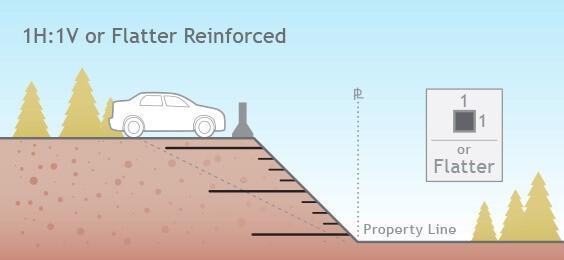
What is commonly referred to as 1H:1V or flatter slopes, are slopes where proportion of the height of the rise is less than or equal to the length of the slope.
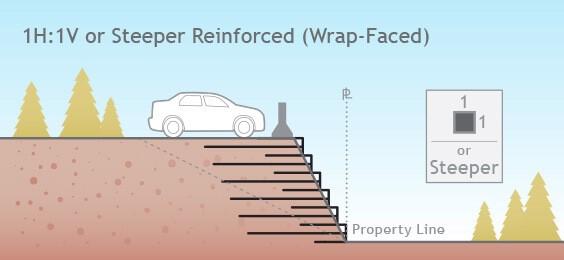
These slopes are classified as slopes where the proportion of the height of the rise is higher than the length of the slope.
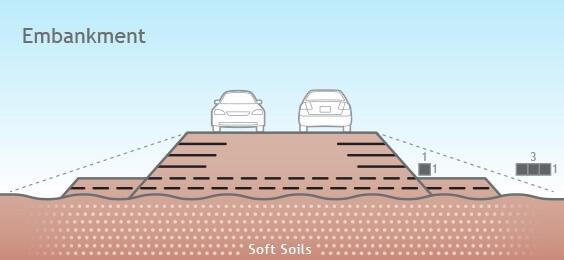
Embankments represent a special class of slopes or walls where soil reinforcement is used to stabilize and construct a fill structure having a smaller footprint than what could be constructed with the soil alone. Embankment stabilization is common when constructing roadways or other structures over soft, weak foundation materials.
Geogrid is a high-strength polymer grid laid in horizontal layers within a retaining wall's backfill. It reinforces the soil in tension — like rebar in concrete — so the wall and its reinforced soil act as one stable mass. StrataGrid uniaxial geogrid (SGU) is designed specifically for this reinforcement.
It depends on wall height, the slope and surcharge above the wall, and soil conditions. As a general guide, segmental block walls taller than about 3 to 4 feet, or shorter walls with a slope or driveway loading above them, usually require geogrid reinforcement. Always follow the engineered design for your project.
Unreinforced segmental block walls are commonly limited to roughly 3 to 4 feet, depending on the block, soil, and any loads above the wall. Beyond that height — or under surcharge loading — geogrid reinforcement is typically required. Your local code and wall engineer set the actual limit.
Uniaxial geogrid (StrataGrid SGU) has its strength concentrated in one direction and is used for retaining walls and steep slopes. Biaxial geogrid (StrataBase SGB) has strength in two directions and is used for base and subgrade reinforcement under roads, driveways, and pads.
The number of layers and the embedment length come from the wall's engineered design, which accounts for height, soil, and loading. As a starting point, estimate the wall face area and the reinforced-zone depth, then confirm quantities against your engineer's drawings. Contact us for roll coverage and StrataGrid grade details for your project.
Several StrataGrid grades are engineered equivalents to common Miragrid grades — for example SGU60 to Miragrid 3XT and SGU80 to Miragrid 5XT. Contact us with your Miragrid callout and we'll confirm the equivalent StrataGrid grade we stock.